
JavaScript Basic: Study Notes For Arrays


Array is our first data structure.

An array lets us to group data in a list. 

For example, we have a group letters A, B, C, D.

var letter = "A";
var letter = "B";
var letter = "C";
var letter = "D";

Those letter variables repeat too much, and we don't want it. Rather than having four separate variables, we can write one variable and inside of it we store those four variables.

var letters = ["A", "B", "C", "D"];   //this is array (// means comment)

Array are indexed starting at 0.

Every slot has a corresponding number. "A" (0), "B" (1), "C" (2), and "D" (3).


  • We can use those indices to retrieve data. If we want to get "A" out of the array, we need to know the index of  "A" which is 0.


  • We can use the indices to update array value. If I want to change the "A" to "M", I can just write like this:


  • We can also use the indices to add a new data. If I want to add a 5th letter "E" in the array, I will write:


We just need to give the new index and give the new value for this index.


Arrays can hold any type of data, too.

var whatever = [ 40, true, "Happy", null];

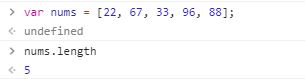
At the end, arrays have a length property. 

If we want to count how many numbers inside an array, we can use length property to figure it out.


Comments

Popular posts from this blog

Intermediate Express.js: How To Add Styles & Partials in EJS File?

So far, we only have simple HTML tags and ejs tags in each ejs file. Every template page has no style at all. And the basic HTML header and footer are also missing. Today, I learned how to add styles and partials in ejs file. Link Style Step One: Touch a Separate CSS file I create a new directory "Style" under the "EJSDemo" directory, then I add a new CSS file "app.css" inside "Style" folder. Step Two: Add app.use(express.static()) in the app.js I add app.use(express.static("style")) in the "app.js". This will tell Express.js to serve the content of "Style" directory. Step Three: Write styles in CSS file I simple give body an orange background color and set text color to be grey. Step Four: Link to CSS file in the EJS file I just add <link> tag to link the "app.css" file on the top of the h1 tag in each ejs template. As the result, when I run the app and...

Intermediate Express.Js: Write Conditions and Loops In The EJS (study note)

We continue to use the app.js which we have build to be the study example. In the last post, we only add a simple EJS tag <%= thingVar %> inside h1 tag. This will match the "thing" to any "thing" request from the user. If Statement Today, the course shows us to write a simple if statement in the EJS file. I learn to apply it to my own app. In the if statement, if users send"/wantto/workout" request, the page will show a new content "Good Idea!". We wrote the if statement in the "diet.ejs" file, and we add "<% %>" tags around the code. We have to wrap every line of JavaScript anytime JavaScript starts and ends. Moreover, you may see there are two types of ejs tags here: <%= %> The one with equal sign. According to the course, when we add equal sign, the value that is returned inside of the tag will be rendered to the HTML page. it will be added to the HTML. For example, if we write ...

Authentication Project: Secret Page App Part One (Set up & Create User Model)

So far we only write the RESTful routes to send request and redirect to the related page, but we haven't do anything about authentication. If we can sign up, login, and log out, it will make our app more meaningful. Therefore, the course shows us how to create a secret page app, which will allow us to sign up, login to a secret page, and logout. Since it requires so many pieces, I will divided this project into three parts: set up & create user model, sign up, and login/logout. In this post, I am going to show all the set up process. Set Up Step One: Install packages The first thing we are going to do to create a folder "Auth", and inside of "Auth", we need to create another folder "AuthDemo". Then we cd (change directory) to "AuthDemo". Now we can set up the actual application structure by installing a few packages: passport, passport-local, passport-local-mongoose, mongoose, express, ejs, body-parser, and express-session....